

A recent brilliant post by the FutureHouse founder Sam Rodriques, sparked a lot of quality discussion in the bio-ML community. It highlights a key tension in the space: the structured nature of foundation models (FMs) versus the unstructured, context-dependent complexity of experimental biology. Having worked at the lab bench and now investing in founders building in this space, this feels very real and close, so here are some recent high-level observations.
The big data vs. hypothesis-driven research debate predates the current trend. While the potential of FMs (predicting cell states, protein interactions, or drug responses) is immense, the transformative discoveries in biology we value most (lncRNAs modulating chromatin or lipid metabolites suppressing immune function), usually emerge from hypothesis-driven exploration.
Indeed, a 2024 paper-of-the-year candidate could easily be Matthias Mann lab’s use of spatial proteomics to unravel a pathway behind a lethal skin disease, rather than a paper directly tied to a SOTA FM. Recent quarters have also brought a potential hypersaturation with bio-FMs, and it is still unclear which ones will actually get deployed at scale.
Historically, in its most recent form, this big data vs. mechanistic research debate became prominent in the mid-to-late 2010s when the emergence of single-cell technologies (spanning primarily the transcription layer of biological information) enabled the creation of cellular atlases. Atlases, like the Human Cell Atlas, provide curated, harmonized datasets mapping cellular diversity across tissues, conditions, and modalities. Leading computational labs set off to improve scale, resolution and quality of tissue-specific atlases, aiming to create a foundational infrastructure that could deepen our understanding of biology.
Mechanistic research was not always exclusively prioritized. A recent review highlights over 700 atlas-like publications published since 2016, with 243 of those in CNS. While atlases brought incredible insights, some of the attention came at the expense of equally valuable mechanistic work. Now, labs that pioneered atlas creation are pushing headstrong toward foundation models. The evolution of bio research from atlases to FMs reflects a natural progression.
This shift coincides with some other macro factors: (1) the rise and incredible promise of transformer models in general ML (since 2017), (2) the success of AlphaFold, and (3) massive seed rounds for bio-FM startups like Bioptimus, Chai Discovery, and EvolutionaryScale. In many ways, FM development is emerging as a central challenge in bio-ML, some form of a holy grail—there’s little choice but to double down.
While I cannot offer a technical perspective on how hybrid approaches might reconcile the structured nature of FMs with the flexibility of natural language, this triggers a broader discussion about a framework for powerful AI in biology. In the wake of the o3 release, it’s hard to ignore the possibility that reasoning gains will translate to biology, with FMs acting as a bridge for this transfer. There are three recurring themes in my thinking around this: deep interdisciplinarity, emergent properties, and scaling laws.
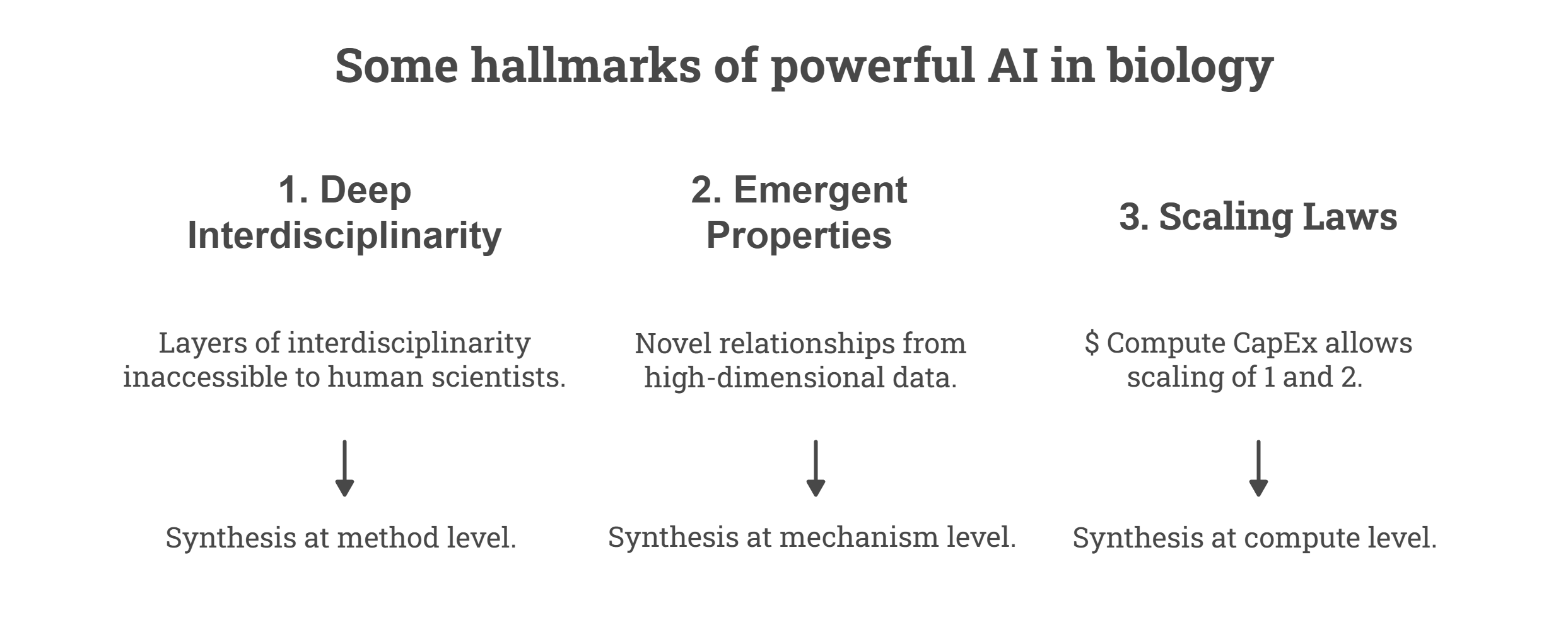
Interdisciplinarity is a buzzword, but biology is arguably the most dependent on it among scientific disciplines. Biology, as a corpus, relies heavily on “borrowed methods” and has often been transformed and reinvigorated by inputs from math,physics, and economics. Examples include the use of Bayesian inference and optimal transport in single-cell analysis, topology and LLPS in genome organization, or CNNs in image analysis. Frontier AI models fine-tuned for these verticals will most likely be much better at “interdisciplinarity” than top scientists in biology. Contracting the turnover time it takes for leaps in frontier ML research to enter biology is the most immediate deep interdisciplinarity benchmark.
As Dario Amodei notes, there’s a luring temptation to see the application of AI systems in biology as an incremental improvement in data analysis. What is actually brewing is some future version of Sakana AI meets FutureHouse meets GenBio AI where much more powerful AI scientists will reason within truly multi-modal bio-FMs. One definitive benchmark for deep interdisciplinarity for me would be for AI to drive technique development. For example, by creating novel methods to study elusive areas of biology, such as the interplay of metabolism and chromatin, testing in real-time the molecular players in transcriptional regulation, or developing new representations that challenge the current structural paradigms.
Emergent properties in bio-FMs would be features that arise not from explicitly encoded rules but from the integration of diverse, high-dimensional data that “independently” leads to uncovering new relationships and mechanisms across datasets. For example, a transformer-based mRNA model might identify novel secondary or tertiary structures crucial for mRNA function - relationships that weren't explicitly encoded but emerged through the model's training. Nicheformer offers a recent inkling of this potential. By leveraging massive spatial datasets, this transformer model predicts cellular niches and reconstructs spatial contexts even from dissociated single-cell data. The broader promise is that FMs can start synthesizing insights that elude single-modality statistical approaches.
The idea that scaling drives progress, as seen in AI, raises the question: how do scaling laws apply to biology? Although the consensus is that biology’s complexity demands a different approach (inverse of traditional ML: given biology’s noise, heterogeneity, and context-dependence) - scaling laws in biology remain largely untested. Perhaps the argument that increasing resolution/sequencing depth (e.g., from Hi-C to Micro-C) or growing dataset size is not enough, and scaling in biology must be multimodal (combining transcriptomics, proteomics, and spatial data) and contextual (tailored to a specific organ or disease phenotype) needs to be tested more aggressively. This would argue for multiple brute-force $100m+ bets into compute/dataset-heavy FMs for Alzheimer’s, aging, autoimmune, and pancreatic cancer.
The excitement around FMs is justified. FMs will offer unprecedented opportunities to integrate structural datasets and generate hypotheses. Yet, for now, the most profound biological discoveries continue to emerge from experimental nuance and deep context. My takeaway: we’re gradually approaching a turning point where FMs will push AI beyond data analysis into biology’s discovery realm. 2025 could mark a shift where FMs begin to rival traditional experimental approaches in driving high-impact biological discoveries.